
Europe’s agriculture needs millions of seasonal workers, but the true number of undocumented, informally employed and exploited people is not known. Migrants working in vineyards are part of this invisible production chain. When Europol found 269 possible victims in an international operation, the result was regarded as a success. What does the figure tell us about the scale of the problem – and why is it so hard to investigate?
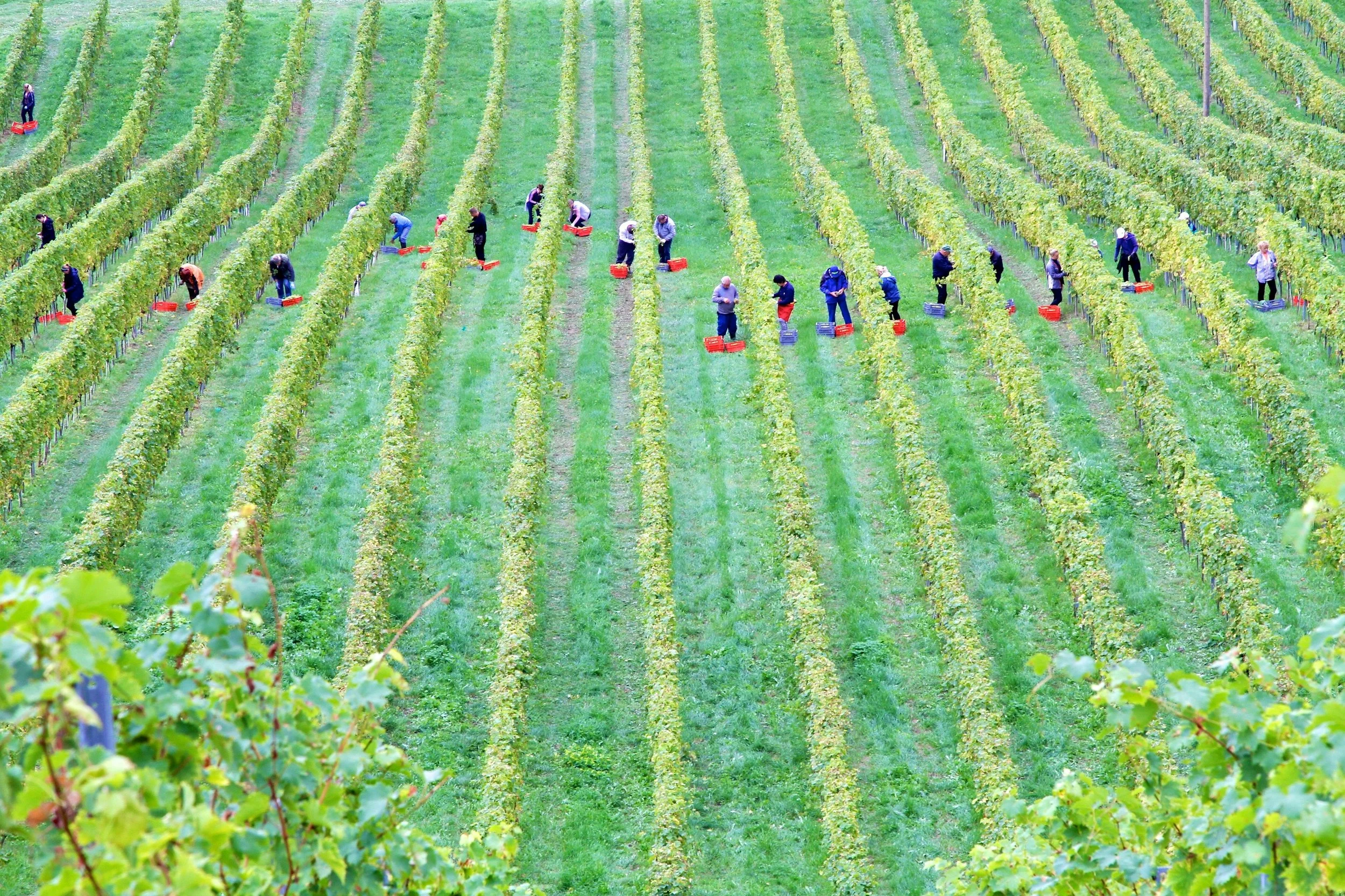
Image: Unsplash / Matthias Mitterlehner
European wine production rests on many things: soil, climate, expertise, capital and markets. One factor of production, however, often remains invisible. It is the person who picks the grapes.
In September 2021, Europol coordinated an international operation in which vineyards, farms and other agricultural workplaces were inspected in several European countries. The operation covered 704 sites and 4,014 people. The result was 269 possible victims of exploitation, of whom 81 were identified as possible victims of human trafficking. The authorities identified 54 suspected human traffickers, arrested 12 people and launched 126 new investigations.
Europol’s press release presented the result as a significant success. The figures should nevertheless be put in proportion to the size of the workforce.
A study published by the European Economic and Social Committee in 2023 estimated that in 2021 EU agriculture employed almost two million domestic or intra-EU mobile seasonal workers and more than 400,000 seasonal workers from outside the EU. That makes more than 2.4 million people – in agriculture alone.
An estimated 71 per cent of seasonal workers from outside the EU were not covered by the system under the Seasonal Workers Directive. This does not mean that all of them were undocumented or working illegally. It does show, however, how large a share of the workforce fell outside the system.
When 269 possible victims turn up in a single operation among more than 2.4 million workers, this is not a measurement of the problem. The figure only tells us how many people the authorities managed to identify during a limited operation. 269 people means 269 individual fates, and finding them matters. Even so, the figure must not be mistaken for an estimate of the size of the problem.
A system of millions of workers whose true size is unknown
A report published by the European Commission in 2026 examines the importance of seasonal workers to the European labour market. In 2024, EU countries issued 273,897 seasonal work permits to non-EU nationals. Italy issued 146,099 of them, more than half, France 41,700 and Spain 20,810.
These are official permits, not estimates of all migrants working in agriculture. Nor do the figures reveal how many work without proper papers, without an employment contract or in conditions that meet the hallmarks of labour exploitation.
This is the core of the problem: Europe knows it needs millions of seasonal workers, but it has no comprehensive, comparable data on how many of them work in exploitative conditions.
Undocumented status, undeclared work and human trafficking are not the same thing, but they can overlap. A worker may be staying in the country legally and still work without a proper contract or be subjected to exploitation of pay and working conditions. An undocumented worker, in turn, is in a particularly vulnerable position, because contacting the authorities can feel like a threat to their right of residence as well.
Truly measuring the problem would require data on all of these different phenomena, not only on the victims of trafficking identified by the police.
The vineyard is only one link in the chain
In the wine regions of Southern Europe, the harvest is a short, labour-intensive phase. The grapes have to be picked at the right time, often within a few weeks. Dozens or hundreds of workers are needed, and the workplaces are often located in remote rural areas.
The recruitment, transport and accommodation of workers can be controlled and arranged by outside intermediaries. In Italy, the system is often called caporalato. The intermediary recruits the labour, arranges transport and may also control the workers’ housing and the payment of wages.
This is not always about the mafia. Caporalato can be independent illegal labour brokering and exploitation. In some areas, however, organised crime can be linked to the activity and profit from it.
A study published in 2018, An Offer that You Can't Refuse? Agrimafias and Migrant Labor on Vineyards in Southern Italy, looked precisely at the link between organised crime and the position of migrant workers in vineyards. The phenomenon is thus not limited to vegetable farms or tomato fields.
In the case of wine this is particularly significant and interesting, because consumers often pay for an impression of quality, origin and craftsmanship. Few people know in what conditions the grapes were picked or who arranged the pickers.
Up to half of the wage can disappear
Even a wage of 4–6 euros an hour does not necessarily end up entirely in the worker’s hands. A report by the European Labour Authority, ELA, describes the Apulia region, where workers were paid 25–30 euros for a 12-hour working day. According to the report, the fees charged for transport, food, accommodation and other arrangements can raise the organiser’s share to as much as 40–50 per cent of the worker’s daily pay.
If a corresponding share is deducted from an hourly wage of 4–6 euros, the worker is left with roughly two or three euros an hour before any other charges. In some cases, no wages are paid at all.
In a report published by El País in 2026, a migrant worker who had worked at an Italian vineyard said they were first paid 3–4 euros an hour but were then left without wages for eight months. The employer had paid the wages to an intermediary, who did not pass them on to the workers. In addition, the workers were charged a daily fee for transport to the fields.
A worker can thus end up paying to get to work, paying for their own transport and accommodation, and finally losing their actual wages as well. This is no longer mere underpayment but a system in which the worker’s dependence is exploited economically.
The difference between nominal pay and real earnings is essential here. When the organiser of the work controls the workplace, transport, housing, and the payment of wages, they can charge fees at every stage. The worker’s real hourly earnings can be a fraction of what the party who has the work done, or the middleman, reports as the wage.
The price of cheap labour shows up directly in a wine estate’s bottom line
In a study carried out in Tuscany, most migrant workers were paid 4–6 euros an hour for their work. Some received even less. A useful point of comparison is the Verona agricultural collective agreement, under which a harvest worker’s hourly wage is 8.37 euros. In addition, the worker accrues a separate TFR payment (severance pay).
An example: a wine estate needs ten workers for a 20-day harvest. The working day is eight hours long, so the work adds up to 1,600 hours.
Gross wages under the legal pay scale come to about 13,400 euros. If the workers are paid 4–6 euros an hour, the same work costs 6,400–9,600 euros in wages. The difference in wages is thus roughly 3,800–7,000 euros.
The calculation compares direct wages only. It does not include the employer’s side costs, insurance, holiday pay, accommodation, transport or the cost of labour brokering. The wage data also come from different regions, so the calculation is an illustrative example, not an official cost comparison for the same region.
In an example with ten workers, the difference can seem small. In a harvest with fifty workers, however, the difference in wages is already almost 19,000–35,000 euros. When the same arrangement is repeated year after year, it is no longer a question of a small saving.
In Lombardy, a legal harvest model has also been developed, in which companies pay, in addition to wages, for transport, accommodation, meals, health care and other services. In 2023, the cost of the system was reported to be about 30 cents per kilo of grapes.
This shows what a lawfully organised labour chain includes. When all costs are handled properly, a wine estate’s production cost is inevitably higher than when part of the costs is shifted onto the workers.
Here lies the core of the distortion of competition. A wine estate operating lawfully pays the costs of the entire production chain. A system based on exploitation can shift part of them onto the workers. Cheaper wine is then not necessarily the result of more efficient production, but wrung out of an undocumented worker’s hide. The worker pays, with their wages, their health and their dignity.
I asked the Commission about this as early as 2023
The problem is not new, and this is not the first time EU institutions have been asked about responsibility.
I raised the matter with the European Commission as early as March 2023. I sent the Commission a question about the systematic exploitation of migrant workers in fruit, vegetable and wine production. I also said that I had tried to look into the matter through various channels but had run into an invisible wall.
Europol had told me that it had not been able to open investigations because no member state had made an investigation request. I had also been in touch with the police authorities of Italy, France and Spain, but received no replies. A German journalist colleague had run into the same problem.
The Commission’s Spokesperson’s Service replied in May 2023. The reply listed directives in force, workers’ rights, training projects and information campaigns. The Commission also said that the European Labour Authority, ELA, can report irregularities it detects to national authorities and cooperate with Europol.
The most essential part of the reply, however, concerned the limits of competence: labour inspections are the responsibility of national authorities. If crimes come to light in inspections, criminal investigation also falls within national competence. The Commission cannot investigate crimes itself.
At the same time, the Commission told me about an international operation led by France in September 2022, in which 16 countries and more than 6,000 officials took part. The operation uncovered labour exploitation in agriculture.
I sent the Commission a further question: where are the practical measures, and how can member states be obliged to report problems to Europol and to national authorities? The reply set out no such binding mechanism.
The Commission’s reply was administratively correct, but it left the real question open: who acts if the member states do not launch an investigation?
The structure is therefore this. The EU recognises the exploitation, legislates on workers’ rights and organises international enforcement operations, but responsibility for investigation lies with the member states. This alone does not prove that member states are knowingly protecting a competitive advantage based on cheap labour. But it does raise the question of whether the current division of responsibility is sufficient – or whether it allows the problem to remain administratively identified but, in criminal-law terms, too often uninvestigated.
When oversight is divided, overall responsibility disappears
Labour exploitation can be linked simultaneously to illegal labour brokering, human trafficking, tax evasion, neglect of social security contributions and organised crime.
Different authorities investigate these matters. Occupational safety authorities inspect working conditions, the police investigate crimes, immigration authorities monitor residence rights and tax authorities monitor companies’ returns. In cross-border activity, international cooperation is needed as well.
Europol is not a federal police force that could launch a criminal investigation in any member state. Its task is to support investigations launched by member states. Article 6 of the Europol Regulation allows it to ask national authorities to open an investigation, but the power to decide remains with the member state. If national authorities do not open an investigation or supply information, the possibilities of Europol and the Commission to intervene are limited.
The 2021 operation showed that cooperation is possible. The 2022 operation showed that thousands of officials can be mobilised for the same task. Neither, however, answers the question of who monitors the problem systematically year after year, who compiles the data of different countries, and who ensures that exploitation is investigated even when it does not lead to a spectacular international police operation.
The competitive advantage of cheap production
European agriculture competes in world markets. Wine, fruit, vegetables and other foodstuffs also compete with imports from outside the EU, so production costs have a direct impact on competitiveness. It is therefore essential to know how large a share of the costs is shifted onto the workers.
The European Commission recognises the problem, and its reports describe undeclared work in agriculture, precarious employment relationships and differences in enforcement between member states. In Italy, a total of 8,847 occupational safety inspections were carried out in agriculture in 2024. Irregularities were found in 68.4 per cent of the inspected sites.
This does not mean that almost 70 per cent of all Italian farms break the law, since the inspected sites are not a random sample. The result nevertheless shows how many problems the authorities find even in selective inspections.
Is Europe also protecting its own competitive position?
There is no evidence that the EU or its member states are knowingly protecting labour exploitation. The question is nevertheless a legitimate one.
The EU knows that agriculture needs millions of seasonal workers. It knows that seasonal work involves widespread insecurity, undeclared work and risks of exploitation. It also knows that enforcement in the member states is fragmented and that the true extent of the problem is hard to measure.
Yet Europe has no comprehensive, comparable system that would tell us how large a share of the agricultural workforce works informally or in exploitative conditions. Nor is enough known about how much such labour distorts competition at the expense of lawfully operating businesses.
Is this only a matter of administrative incapacity and the division of responsibility between member states? Or is it also politically easier to look at the problem narrowly, because cheap labour supports the competitiveness of European agriculture?
The accountability of European agriculture is not measured by how many exploited workers the police find in a single week. It is measured by whether the system can prevent exploitation, protect workers and ensure that illegal labour is not used to gain a competitive advantage.
269 people means 269 individual fates. Finding them matters. But 269 is not a measure of success.
It is a reminder of how little we know.
Sources
1. European Economic and Social Committee (EESC), 2023. Social protection of seasonal workers in the EU. A study on the number of seasonal workers in EU agriculture and on workers falling outside the scope of the Seasonal Workers Directive. The estimates are based on the situation in 2021. Original report (PDF)
2. European Commission, 8 May 2026. Report on the application of Directive 2014/36/EU on seasonal workers – COM(2026) 261 final. Numbers of seasonal work permits, working conditions and member states’ enforcement practices. European Commission report
3. Europol, 5 October 2021. Labour in vineyards and farms checked across Europe – 269 possible victims of exploitation were identified during the action week. Results of the international operation of 9–16 September 2021: 269 possible victims of exploitation, 81 possible victims of human trafficking, 54 identified suspects and 12 arrests. Europol’s original press release
4. Fabio Berti, 2023. Labor exploitation in the Italian agricultural sector: the case of vulnerable migrants in Tuscany. Frontiers in Sociology. An interview study on the wages and working conditions of migrant workers in Tuscany. The full study
5. Stefan Seifert & Marica Valente, 2018. An Offer that You Can't Refuse? Agrimafias and Migrant Labor on Vineyards in Southern Italy. DIW Berlin Discussion Paper 1735. A study on the link between organised crime, the caporalato system and migrant labour in vineyards in Southern Italy. Study details and abstract · Study as PDF
6. FAI CISL Verona. Retribuzioni per i lavoratori di aziende agricole. Pay scale of the Verona agricultural collective agreement, valid 1 January 2024 – 31 December 2027. Hourly wage of a harvest worker (level 8) 8.37 euros and TFR accrual 0.55 euros per hour. Verona agricultural pay scale
7. Fondazione Metes, April 2025. Attività di vigilanza dell’Ispettorato Nazionale del Lavoro in agricoltura nel 2024. Statistics on occupational inspections in Italian agriculture. In 2024, 8,847 inspections were carried out and irregularities were found in 68.4 per cent of the inspected sites. Italian agricultural inspection statistics
8. European Commission, Spokesperson’s Service, 12 May 2023. Email reply to Winepress’s enquiry Human rights violations at wine estates (Finnish original: Viinitilojen ihmisoikeusrikkomukset), March–May 2023. The Commission’s reply addresses the directive on sanctions against employers, the Seasonal Workers Directive, the competence of the European Labour Authority ELA and the responsibility of national authorities for labour inspections and criminal investigations. The reply also describes the international operation against labour exploitation in agriculture in September 2022, in which 16 countries and more than 6,000 officials took part. Original email correspondence, 7 March – 12 May 2023, Winepress archive.
Notes on interpreting the sources
• Europol’s 269 individuals are possible victims identified during a single limited operation. The figure is not an estimate of the total amount of exploitation.
• The EESC’s 71 per cent figure refers to seasonal workers from outside the EU who were not covered by the system of the Seasonal Workers Directive. It does not mean that they were undocumented.
• The wage findings of the Tuscany study and the Verona pay scale come from different regions. The calculation based on them is illustrative, not an official regional cost comparison.
• The 68.4 per cent share of irregularities in Italian inspections concerns inspected sites, not all Italian farms.
• No direct evidence is presented here of the EU or member states knowingly protecting exploitation for the sake of a competitive advantage. It is raised in the column as a question to be investigated.